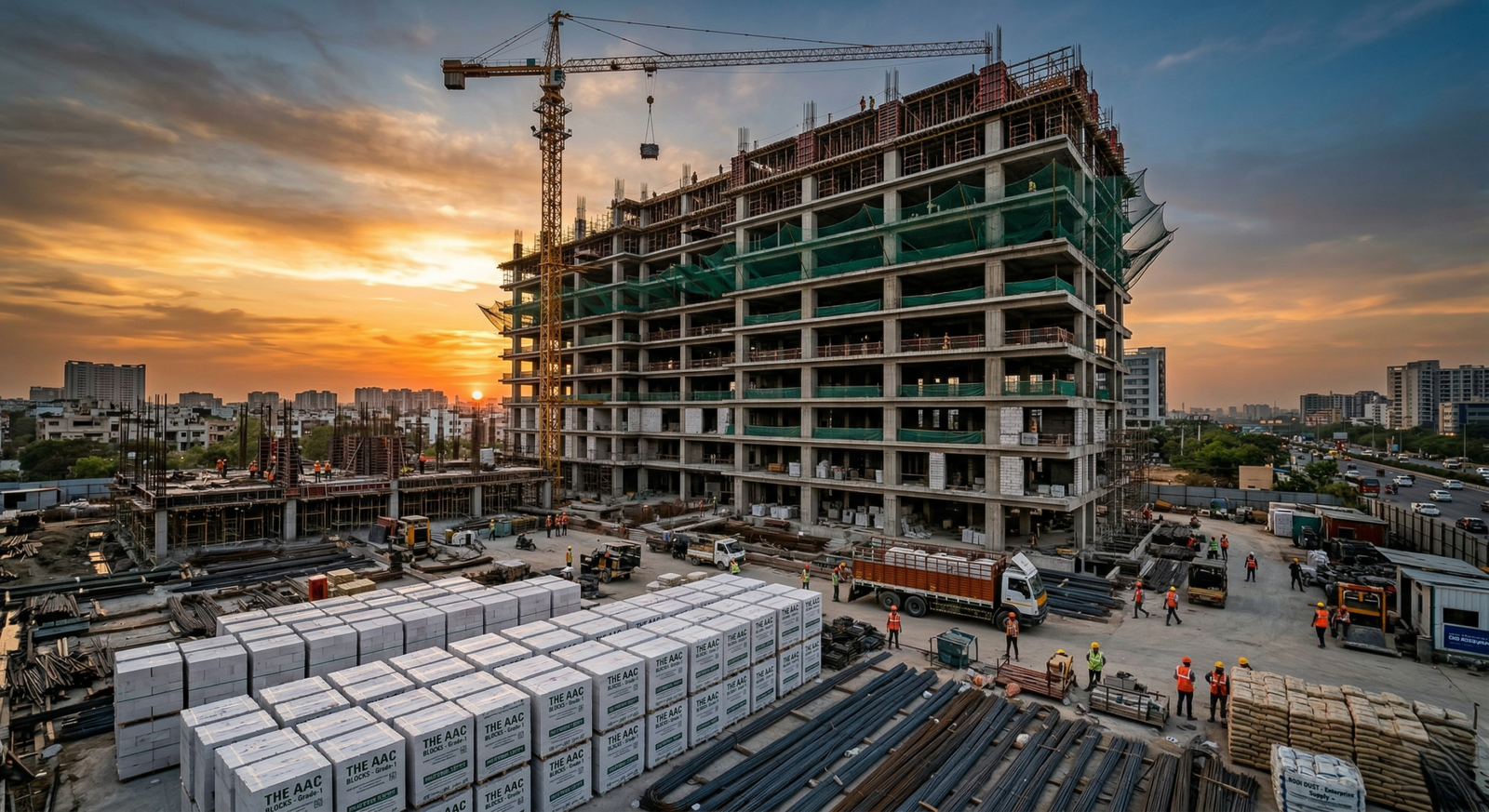
If you are planning a residential, commercial, or industrial construction project in India, you have likely been advised to replace traditional red clay bricks with AAC blocks. But what exactly are they, and why are they fundamentally changing modern masonry?
This comprehensive guide covers everything from the chemical manufacturing process of AAC blocks to their structural benefits, standard sizes, and how they reduce your total construction costs.
What Does AAC Stand For?
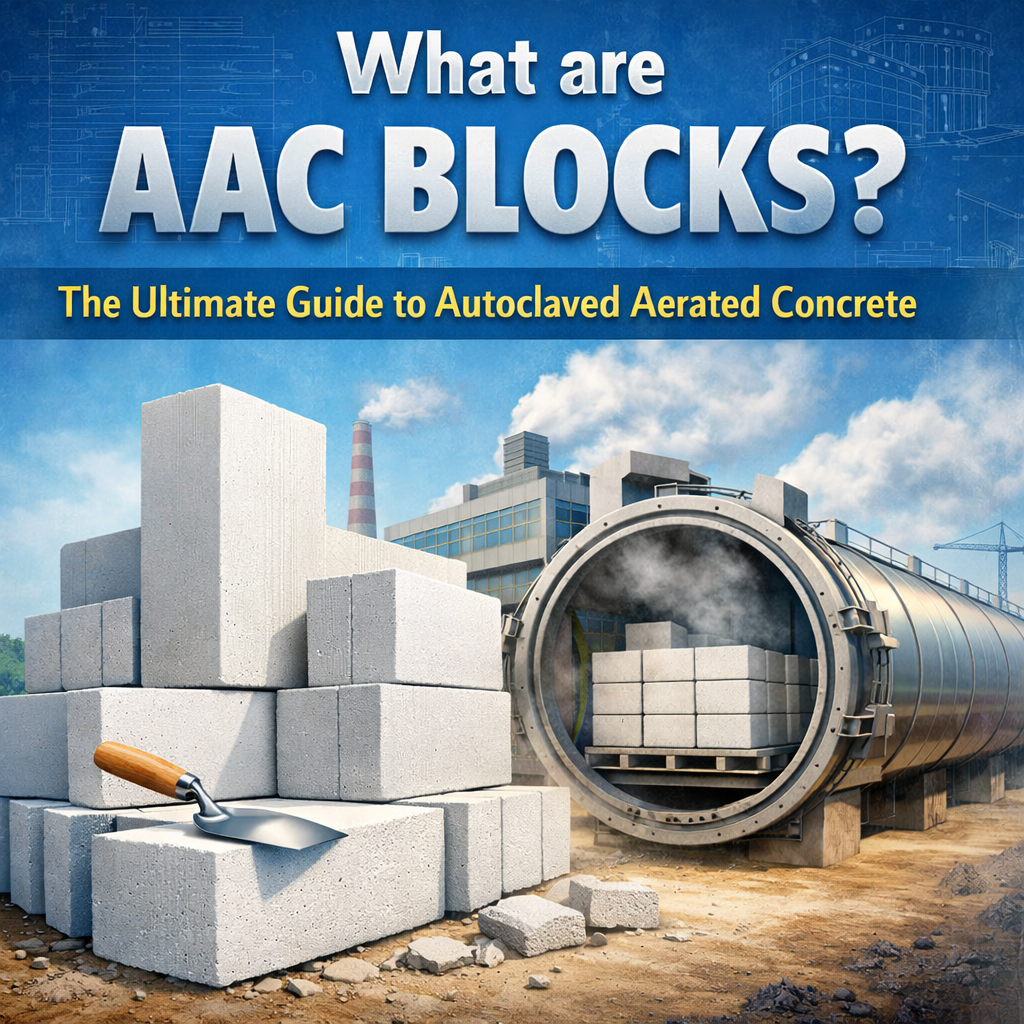
AAC stands for Autoclaved Aerated Concrete. Also known as Autoclaved Cellular Concrete, it is a lightweight, precast, foam concrete building material. Unlike traditional bricks that are baked in kilns using fertile topsoil, AAC blocks are precision-engineered in highly controlled factory environments using recycled industrial byproducts.
The Science Behind the Block: Raw Materials & Manufacturing
AAC blocks are not just “light concrete.” They are a highly specialized chemical composition designed for structural durability and thermal efficiency.
The Raw Materials
The primary ingredients include:
- Fly Ash: Acting as the silica-rich base, fly ash (a byproduct of thermal power plants) constitutes about 60-65% of the block, making it an eco-friendly and sustainable material.
- Cement & Lime: These act as the primary binding agents, giving the block its initial structural stability.
- Aluminum Powder: This is the crucial “aeration” agent. When added to the mix, it reacts with the alkaline lime to generate hydrogen gas.
- Gypsum & Water: Gypsum regulates the setting time, while water activates the chemical reactions.
The Manufacturing Process
- Aeration (The “Green Cake”): Once the materials are mixed into a slurry and poured into steel molds, the aluminum powder triggers a reaction. The hydrogen gas escapes, creating millions of microscopic air bubbles. The mixture expands like rising dough into a porous mass known as a “green cake”.
- Precision Wire Cutting: Before it fully hardens, the green cake is removed from the mold and cut into perfectly accurate block dimensions using high-tensile steel wires.
- Autoclaving: The cut blocks are placed into massive pressure chambers called autoclaves. Here, they are steam-cured at extreme temperatures (180°C to 220°C) and high pressure (10-12 bar) for 10-12 hours. This hydrothermal process creates Tobermorite crystals, which transform the porous foam into a rigid, high-strength masonry unit.
Top 5 Engineering Advantages of AAC Blocks
Why are top builders, structural engineers, and architects making AAC the industry standard?
1. Massive Dead Load Reduction (Lightweight) AAC blocks have an oven-dry density of 550–650 kg/m³, which is roughly one-third the weight of traditional red clay bricks (1800-2000 kg/m³). This massive reduction in dead weight lowers the load on the building’s foundation, saving up to 15% on structural steel and concrete costs.
2. Superior Thermal Insulation Thanks to the millions of trapped air cells, AAC blocks possess an exceptional thermal conductivity (K-value) of 0.16 W/mK. This means they keep interiors cool in the summer and warm in the winter, potentially reducing your HVAC (air conditioning) electricity bills by up to 30%.
3. Exceptional Acoustic (Sound) Insulation If you are building in a noisy urban environment like Delhi-NCR, AAC blocks are a game-changer. A standard 200mm thick AAC wall offers a Sound Transmission Class (STC) rating of 40–45 dB, ensuring virtually soundproof interiors ideal for hospitals, hotels, and homes.
4. High Fire Resistance AAC is a non-combustible material with a melting point of over 1600°C. Depending on the thickness of the block, an AAC wall can withstand direct fire for 2 to 6 hours, drastically enhancing occupant safety.
5. Faster Construction with Thin-Bed Mortar Because AAC blocks are manufactured with tight dimensional tolerances (± 1.5 mm), they do not require thick 15mm cement mortar joints. Instead, they are installed using a specialized Polymer-Modified Block Jointing Mortar applied at a thickness of just 2-3 mm. This eliminates the need for water curing, reduces mortar consumption by 75%, and speeds up wall construction by up to 3 times.
Standard Sizes & IS 2185 Part 3 Compliance
In India, the quality, dimensions, and testing of AAC blocks are strictly governed by the Bureau of Indian Standards under IS 2185 (Part 3): 1984. Always ensure you are purchasing Grade-1, ISI-marked blocks.
Standard Block Dimensions:
- Length: 600 mm
- Height: 200 mm (or 250mm for specific brands like JK Smartblox)
- Thickness: 75mm, 100mm, 150mm, 200mm, 225mm, and 300mm
A 100mm (4-inch) block is typically used for internal partition walls, while a 200mm (8-inch) block is recommended for external walls to maximize thermal insulation and load-bearing capacity.
Why Source Through TheAACBlocks.com?
In the modern construction landscape, material authenticity and supply chain reliability are just as critical as the product itself.
TheAACBlocks.com is the dedicated digital distribution nexus of Rodi Dust Marketing & Distributions Pvt. Ltd., an institutional leader in building materials headquartered in Gurugram, Haryana.
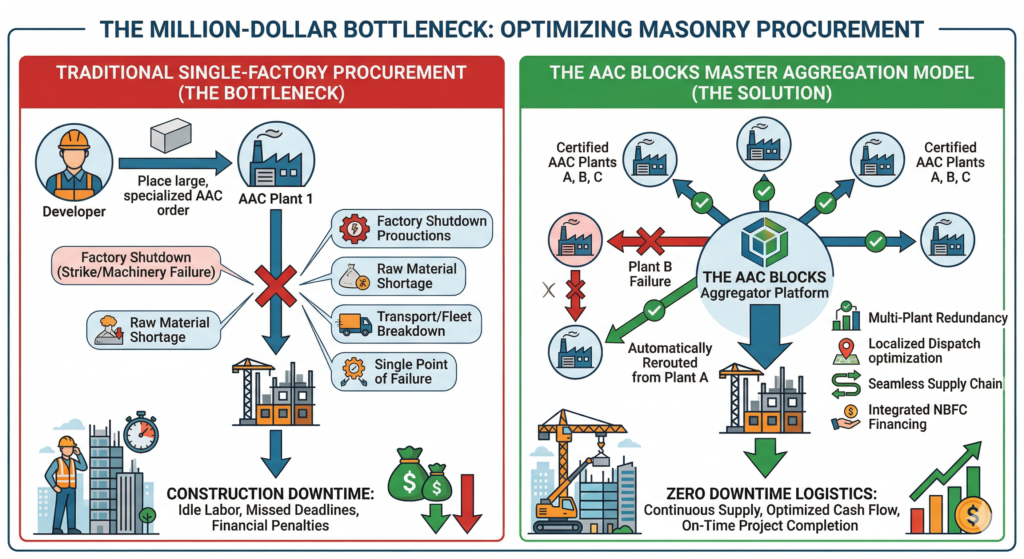
- Authorized Multi-Brand Dealership: We don’t just sell blocks; we provide solutions. We are the authorized distributors for India’s top AAC manufacturers, including Magicrete, JK Lakshmi Smartblox, Biltech, Shree Heatshield, and Birla Aerocon.
- Real-World Logistics: AAC blocks are volumetric. Transporting them requires heavy infrastructure. We operate our own dedicated fleet of 15 cbm, 27 cbm, and 45 cbm trucks, ensuring safe, cross-border delivery straight from the factory to your site.
- Technical Authority: Every batch we supply comes with documented compliance to IS 2185 (Part 3) and corresponding lab test reports, guaranteeing you receive Grade-1 material for your project.
Ready to modernize your construction project with AAC blocks? Eliminate procurement headaches and get direct-to-site delivery. Contact TheAACBlocks.com today for a customized quote based on your region and volume requirements.